
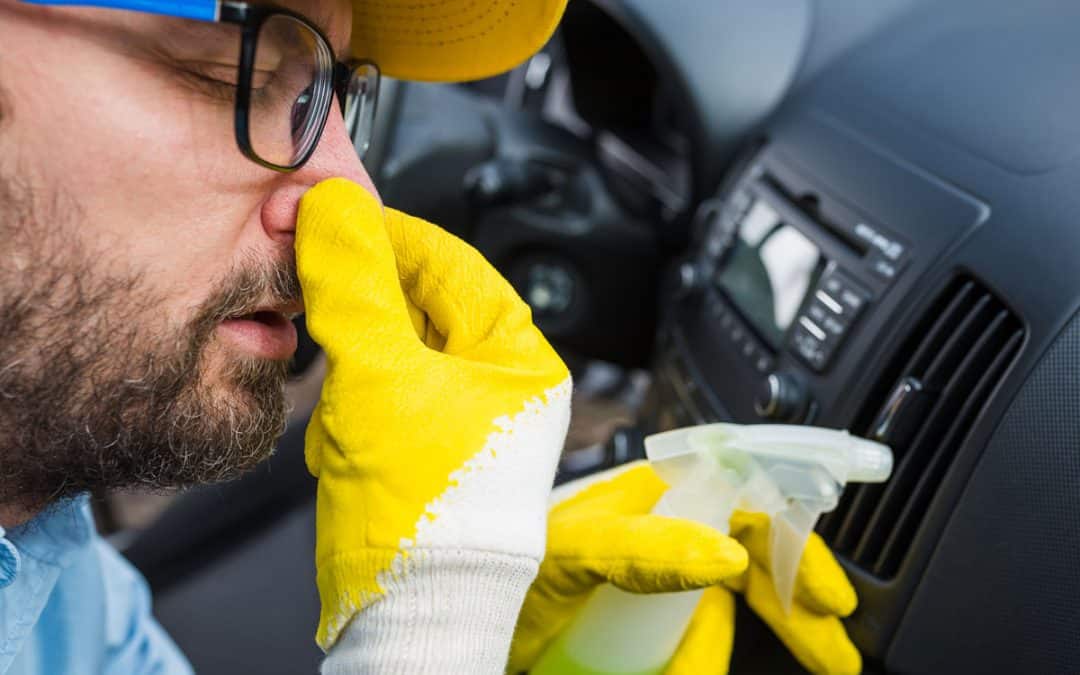
Ozone can help with a stubborn smell after the cleaning is done. It will not remove the cause. If the source of the smell is still in the car, the smell comes back. Ozone is also a lung irritant, so it has to be run the right way. Here is how detailers handle an odor job: find the source, clean it, then treat the empty car and air it out.
Why car odors hang on
A car interior is a small, sealed box full of things that soak up smells: carpet and pad, seat foam, headliner fabric, seat belts and the HVAC system. Odors usually come from one of these:
- Smoke. Tobacco and cannabis smoke leave a sticky film on glass, plastic, the headliner and inside the vents.
- Pets. Hair, dander and especially urine that soaks through the carpet into the pad.
- Mildew. Water from a leaking door seal, sunroof drain, cowl or heater core keeps the carpet pad damp.
- Food and milk. A spilled shake or a burger dropped under a seat track turns sour fast in a hot car.
- The HVAC system. A dirty cabin air filter and a damp evaporator core can make the whole car smell musty every time the fan comes on.
Step 1: Find the source first
Ask the customer when the smell started and where they notice it. Then check:
- Under and between the seats, the seat tracks and the seat-back pockets.
- Carpet and pad, especially the rear footwells and the trunk well. Press down with a dry towel. If it comes up damp, you have a water leak.
- The headliner and visors. Wipe a spot with a white towel and a little cleaner. Smoke film comes up yellow.
- The cabin air filter. Pull it and look.
- The vents. Run the fan on high, then on recirculate, and smell each one.
Standing water or a wet pad? Fix the leak and dry the car first. Ozone does not dry carpet, and a wet pad keeps growing mildew.
Step 2: Clean the source
Ozone is the last step, not the first. Do the real cleaning first:
- Vacuum everything, including under the seats and in the seat tracks.
- Hot water extraction of carpet and cloth seats. For pet urine and food, use an enzyme cleaner made for automotive carpet, give it the dwell time on the label, then extract. See our guides to auto carpet cleaning and cleaning car seats with household products. If the foam is damaged, see car upholstery repair.
- Wipe every hard surface on smoke jobs: dash, door panels, inside glass, seat belts pulled all the way out, and the headliner with a light touch so you don’t loosen the glue.
- Replace the cabin air filter and treat the evaporator with a product made for that job, following the label.
- Dry the interior with fans or the car’s heat before the ozone step.
After this cleaning, the smell is often gone and ozone is not needed. When the smell lives in the foam, the headliner or the ducts, ozone earns its fee.
What ozone is and why it works on odors
Ozone is a molecule made of three oxygen atoms (O3). It reacts with some of the chemicals that cause odors and changes them into other compounds. The U.S. EPA notes that ozone is used in unoccupied spaces for some odor jobs, such as fire restoration, and that conditions must be set so that no person or pet is exposed (EPA: Ozone Generators that are Sold as Air Cleaners).
The same EPA page warns that ozone reacts with some chemicals to form by-products, and that ozone can damage rubber, electrical wire coatings and fabrics. That is one more reason to use it in short, controlled sessions instead of leaving a machine running overnight.
How an ozone generator works
Most detailing units use corona discharge. An electric field splits oxygen molecules in the air, and some of them recombine as ozone. A fan pushes that air out. Units are rated by output in milligrams per hour (mg/h). A higher-output unit treats a car faster and leaves less room for error. For what to carry on a mobile rig, see mobile detailing equipment.
Step 3: Run the ozone treatment safely
Follow your machine maker’s instructions first. This is the general routine many detailers use.
- Empty the car. No people, pets or plants inside. Take out the customer’s personal items, child seats and anything fragile.
- Set up outside or in a ventilated bay, away from open doors to your shop, your office, and where people walk. Put up a sign or cone so nobody opens the car mid-cycle.
- Place the unit on the floor or on a towel on the center console, pointed into open space, not against upholstery. Some units can run outside the car with a hose through a cracked window; follow the maker’s setup.
- Run the HVAC on recirculate with the fan on low so ozone moves through the ducts, only if the maker’s instructions allow it. Use accessory power, never idle the engine in a bay or garage, and never with anyone inside.
- Close the doors and run a short cycle. Use the timer on the unit and the run time the maker lists for vehicle interiors. For heavy smoke, many detailers run two or three shorter sessions with airing out in between instead of one long session.
- Nobody gets in or stands next to the car while it runs.
- When the cycle ends, wait the re-entry time the maker lists, then open every door and the trunk from arm’s length and let the car air out for at least the time the maker lists. Run the fan on fresh air during this step. Don’t rely on your nose: EPA notes that your sense of smell for ozone fades fast and that no smell does not mean the air is safe. An ozone meter is the better check.
- Smell-check after airing out. If the original odor is still there, look for a source you missed before you run another cycle.
Why the rules are strict: ozone irritates the lungs even at low levels. OSHA’s workplace limit is 0.1 parts per million averaged over 8 hours, and NIOSH lists 5 ppm as immediately dangerous to life or health (NIOSH Pocket Guide: Ozone). The treatment works by holding ozone inside a sealed car, so the air in that car is not safe to breathe until it has aired out. Protect yourself and your crew the same way you protect the customer: stay out of the car until it has aired out.
What ozone does not do
- It does not clean. Dirt, stains, hair and urine stay put until you remove them.
- It does not fix a wet car. Stop the leak and dry the pad first.
- It is not a disinfection or sanitizing service. Don’t sell it that way. When ozone generators are sold to kill germs or viruses, EPA treats them as pesticidal devices. It does not routinely review their safety or effectiveness, so it can’t confirm they work against the virus that causes COVID-19. EPA also warns that selling devices with false or misleading claims can bring penalties under federal pesticide law, and that the claim “Kills COVID-19” is always considered false and misleading (EPA: Why aren’t ozone generators on List N?). Sell odor removal, period.
What ozone odor removal costs
Prices vary by market and by how bad the car is. An add-on to an interior detail costs less than a full odor package that includes extraction, headliner work and several ozone sessions. Shop current prices on commercial ozone generators before you buy.
Price the cleaning, not the machine time. The cleaning is most of the labor.
How to sell odor removal
Odor customers have a reason to act now: a used car they just bought, a trade-in coming up, a car someone smoked in, a dog that got sick on the back seat. They already know they have a problem, which makes them easy to talk to.
Sample ad copy:
Smoke, pet or mildew smell in your car? We find the source, deep clean it, then run an ozone odor treatment in the empty, sealed car and air it out before you pick it up. Call for a quote.
Do not add “disinfects”, “sanitizes”, “kills germs” or “kills viruses”.
Car dealers and used car lots also need odor work. See our page on auto reconditioning for working with dealers.
Frequently asked questions
How long should you run an ozone generator in a car?
Follow the run time your machine maker lists for vehicle interiors. Many detailers run short sessions and repeat with airing out in between for heavy smoke instead of running one long session.
Is ozone safe for a car interior?
Short, controlled treatments are common in detailing. EPA notes that ozone can damage rubber, wire coatings and fabrics, so avoid overnight runs and repeated long sessions.
How long after an ozone treatment can I drive my car?
Wait the re-entry time your machine maker lists, then open every door and air the car out for at least the time the maker lists. Don’t rely on smell to decide it’s clear. Nobody should sit in the car before then.
Will ozone remove cigarette smoke smell?
Ozone can help with smoke odor that has soaked into the headliner, foam and ducts, but only after the surfaces are wiped down and the cabin filter is replaced. Heavy smoke cars often need more than one session.
Does ozone kill bacteria and viruses in a car?
Don’t buy or sell ozone for that. EPA does not routinely review ozone generators for safety or effectiveness against germs, and it warns that false or misleading claims about these devices can bring penalties. Use ozone for odors only.
Why does my car still smell after ozone?
The source is usually still there: a damp carpet pad, urine in the foam, a dirty cabin filter or a wet evaporator. Find it, clean or fix it, then treat again.